InstagramCoach Rudy @coachingotf
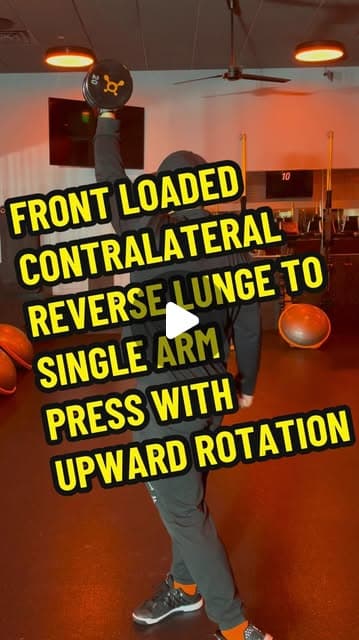
1 of 4Front Loaded Contralateral Reverse Lunge to Single Arm Press with Upward Rotation
4 videos with creator attribution, movement metadata, and coaching context.
Movement Type
compound
Muscle Groups
quads, glutes
Equipment
bodyweight
Creators
1 creator
Front Loaded Contralateral Reverse Lunge to Single Arm Press with Upward Rotation
Lateral Bound to Reverse Lunge Plyometrics are generally categorized into either short response or long response. Lateral bounds are a long response where we take time to load, explode, and then absorb force. To keep members successful start off with a small distance to get used of the balance it requires in the lateral movement. As they move through the timed section, ideally they would open up more range still controlling the balance. With this as a primer, we want to move through a big range of motion in the lunge, opening up range at the hip and knee.
Alternating Reverse Lunge Reverse lunges are often easier on the knees than forward lunges. We do want to keep an upright torso vs hinging. We should also be pretty analytical when it comes to options. Can we maintain the intended stimulus (heavy, endurance, TUT…)? Can we maintain the intended movement pattern target (squat, hinge, lunge…)? Can we maintain unilateral vs bilateral? All of this should be considered for the given option.
Alternating Forward Lunge Even though the majority of lunge we see are reverse lunges. There is a good amount of value in a forward lunge with an upright torso. Not only is a bit more quad biased, it gives us an opportunity to strengthen the musculature around the knee. If there is discomfort at the knee, we can always have the try stepping out further, or even going to that reverse lunge.